Office renovation is an exciting step for any business. Whether you’re expanding your team, modernizing your workspace, rebranding your office, or improving employee productivity, a well-planned renovation can transform the way your company operates. However, for many business owners, HR teams, facility managers, and office administrators, one concern outweighs everything else business downtime.
Every hour your office is unable to function efficiently can lead to lost productivity, delayed projects, disrupted customer service, and financial losses. This is why minimizing downtime during an office renovation isn’t just a construction challenge; it’s a business priority.
In a fast-paced business environment like Delhi NCR, where companies operate under tight deadlines and client expectations, shutting down operations for weeks simply isn’t an option. The good news is that with proper planning and the right turnkey interior contractor, your office can undergo a complete transformation while your business continues to operate smoothly.
In this comprehensive guide, we’ll explain practical strategies that help businesses renovate their offices without disrupting daily operations. Whether you’re planning a workspace redesign, office expansion, complete fit-out, or commercial renovation, these insights will help you make informed decisions and avoid costly mistakes.
Why Business Downtime During Office Renovation Is So Expensive
Many companies underestimate the true cost of downtime. They often focus only on the renovation budget while ignoring the financial impact of disrupted operations.
Downtime affects much more than your office space. It influences employee productivity, customer experience, internal communication, project timelines, and even your company’s reputation.
Some of the hidden costs include:
- Employees unable to work efficiently
- Delayed project deliveries
- Missed client meetings
- Reduced employee morale
- Temporary relocation expenses
- IT and network interruptions
- Noise affecting productivity
- Delays in business decisions
- Loss of revenue due to operational interruptions
For businesses in Delhi NCR, where competition is intense, even a few days of unnecessary disruption can have long-term consequences.
This is why successful companies prioritize renovation planning as much as the design itself.
Why Some Office Renovations Create More Downtime Than Others
Not every renovation leads to major disruption.
The biggest difference usually comes down to planning.
Businesses that experience long delays often make one or more of these mistakes:
Starting Without Proper Planning
Beginning demolition before finalizing drawings, material selections, or approvals almost always causes delays.
Every design change made during execution increases costs and extends project timelines.
Professional turnkey contractors complete detailed planning before any work begins.
Choosing Contractors Based Only on Price
Many companies award projects to the lowest bidder without evaluating execution capability.
Unfortunately, low quotations sometimes result in:
- Poor project management
- Delayed material procurement
- Lack of skilled manpower
- Frequent design revisions
- Missed deadlines
- Additional hidden costs
Instead of focusing only on price, businesses should evaluate experience, previous projects, financial stability, quality standards, and execution processes.
A reliable contractor protects your business continuity not just your renovation budget.
Poor Communication Between Teams
Office renovations involve multiple stakeholders:
- Management
- HR
- Administration
- IT
- Employees
- Architects
- Interior designers
- Vendors
- Contractors
Without clear communication, confusion quickly develops.
Employees may not know which areas remain operational.
IT teams may not prepare for server relocation.
Department heads may schedule meetings in spaces under construction.
Regular project coordination prevents these issues before they occur.
The Importance of Choosing the Right Renovation Strategy
Every office is different.
Some businesses can temporarily relocate.
Others must continue operating throughout the renovation.
Your renovation strategy should match your operational requirements.
For example:
Full Relocation
Suitable for companies with flexible work arrangements or temporary office space.
Advantages:
- Faster execution
- Better productivity for contractors
- Reduced safety concerns
- Lower overall project duration
Disadvantages:
- Temporary relocation costs
- Employee inconvenience
- Additional logistics
Phased Renovation
This is one of the most common approaches for occupied offices.
Instead of renovating the entire office at once, work is divided into phases.
For example:
- Phase 1: Reception
- Phase 2: Workstations
- Phase 3: Meeting rooms
- Phase 4: Director cabins
- Phase 5: Pantry
- Phase 6: Breakout areas
Employees continue working while different sections are completed one by one.
This significantly reduces operational disruption.
Weekend and Night Execution
Many businesses in Delhi NCR choose to execute high-impact work during evenings, weekends, or public holidays.
This includes:
- Flooring installation
- Ceiling work
- Electrical shutdowns
- Glass installation
- Furniture shifting
- Painting
- IT cabling
When employees return to work the next morning, major activities have already been completed.
Start Planning Earlier Than You Think
One of the biggest reasons renovations get delayed is late planning.
Many companies contact contractors only after signing a lease or deciding to renovate.
By that point, valuable planning time has already been lost.
Ideally, planning should begin several weeks or even months before execution.
Early planning allows time for:
- Site surveys
- Space planning
- Budget estimation
- Design development
- Material selection
- Government approvals (if required)
- Vendor finalization
- Furniture planning
- Procurement scheduling
- IT coordination
The more decisions finalized before execution begins, the fewer surprises you’ll face during construction.
Conduct a Detailed Site Assessment
Every successful renovation starts with understanding the existing space.
Before preparing quotations or timelines, experienced contractors perform a thorough site assessment.
This includes evaluating:
- Existing electrical systems
- HVAC condition
- Fire safety infrastructure
- Plumbing
- Flooring
- Ceiling
- Lighting
- Server room requirements
- Structural limitations
- Access routes
- Loading and unloading areas
Identifying these factors early prevents unexpected delays once work begins.
Create a Realistic Timeline
Many businesses ask contractors one question:
“How quickly can you finish?”
While speed is important, unrealistic timelines often create bigger problems.
Rushed projects frequently suffer from:
- Poor workmanship
- Rework
- Material shortages
- Safety risks
- Quality issues
- Budget overruns
Instead, create a realistic timeline with clearly defined milestones.
Typical milestones include:
- Design approval
- Material procurement
- Civil work
- Electrical work
- HVAC installation
- Ceiling completion
- Flooring
- Painting
- Furniture installation
- IT setup
- Final cleaning
- Snag rectification
- Project handover
Tracking progress against milestones keeps the renovation on schedule and minimizes disruption to daily operations.
Involve Every Department Before Work Begins
Office renovations affect more than just facilities teams.
Each department has unique operational needs that should be considered during planning.
For example:
HR may need uninterrupted interview rooms and employee seating.
Finance may require secure document storage and continuous system access.
Sales teams often need meeting rooms for client presentations.
IT teams must plan network migration, server relocation, internet connectivity, access control systems, and workstation setup.
Gathering input from each department before construction starts reduces last-minute changes and helps the renovation progress smoothly.
The Role of a Turnkey Interior Contractor
One of the biggest reasons office renovations get delayed is the involvement of multiple vendors working independently.
When separate contractors handle civil work, electrical systems, HVAC, furniture, networking, painting, and project management, coordination becomes difficult. Even a small delay by one vendor can affect the entire schedule.
A turnkey interior contractor simplifies this process by managing every stage of the project under one roof. From planning and procurement to execution, quality checks, and final handover, a single team is responsible for delivering the project on time.
This centralized approach reduces communication gaps, improves accountability, ensures better scheduling, and significantly minimizes business downtime.
How to Minimize Business Downtime During Office Renovation: A Complete Guide for Businesses in Delhi NCR
In Part 1, we discussed why business downtime is expensive, the importance of early planning, and how choosing the right renovation strategy can keep your operations running smoothly.
Now, let’s explore the practical strategies successful businesses use to renovate their offices while maintaining productivity.
- Divide the Renovation into Phases
One of the most effective ways to reduce downtime is to avoid renovating the entire office at once.
Instead, divide the project into manageable phases.
For example:
- Phase 1 – Reception and waiting area
- Phase 2 – Open workstations
- Phase 3 – Meeting and conference rooms
- Phase 4 – Director cabins
- Phase 5 – Pantry and cafeteria
- Phase 6 – Breakout and collaboration zones
Employees can continue working in unaffected areas while construction progresses in other sections.
A phased approach not only minimizes disruption but also allows management to monitor progress and make adjustments if required.
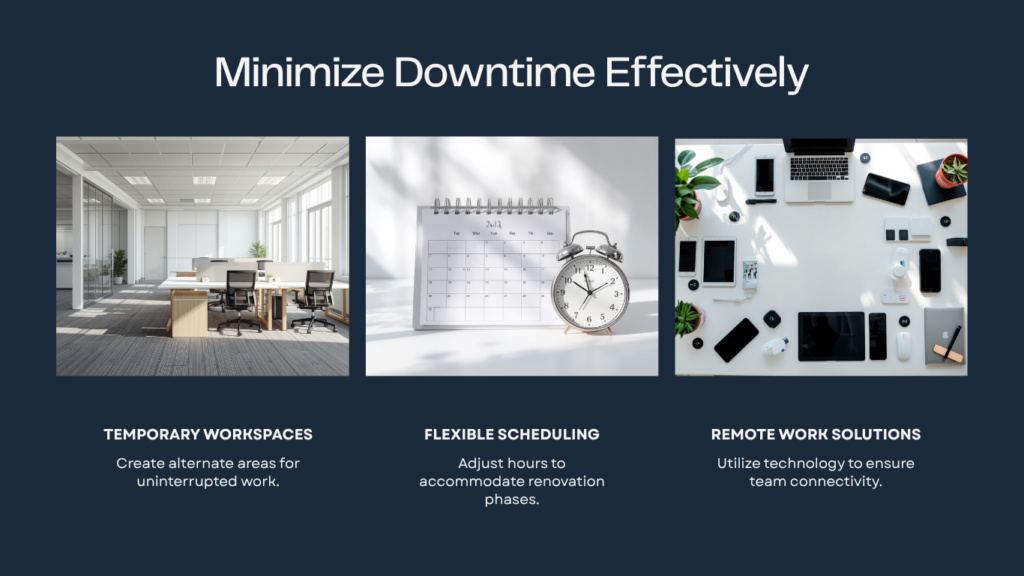
- Schedule High-Impact Work Outside Business Hours
Certain renovation activities are noisy, dusty, or require temporary shutdowns of utilities.
Examples include:
- Tile removal
- Wall demolition
- Core cutting
- Ceiling dismantling
- Electrical shutdowns
- HVAC installation
- Server room modifications
- Glass partition installation
- Furniture shifting
Rather than performing these tasks during office hours, schedule them during evenings, weekends, or public holidays.
Employees arrive the next morning to a cleaner, quieter, and more functional workspace with minimal interruption to their daily work.
- Create Temporary Workspaces
If a department is undergoing renovation, relocate employees temporarily instead of sending them home.
Options include:
- Vacant meeting rooms
- Training rooms
- Unused office sections
- Temporary cabins
- Co-working spaces
- Hybrid work arrangements
Maintaining operational continuity is often more valuable than the inconvenience of temporary seating arrangements.
- Support Hybrid and Remote Working
The rise of hybrid work has made office renovations much easier.
Departments that do not require a physical presence every day can work remotely while renovation is underway.
Typical roles suitable for temporary remote work include:
- Finance
- Human Resources
- Marketing
- Customer Support
- Software Development
- Design Teams
- Administration
Reducing the number of people in the office also improves safety and allows contractors to work more efficiently.
- Finalize All Designs Before Execution Begins
One of the biggest causes of project delays is changing the design after work has started.
For example:
- Moving partitions
- Changing flooring materials
- Selecting different furniture
- Modifying lighting layouts
- Revising workstation sizes
Every design change affects procurement, scheduling, labour allocation, and costs.
Professional contractors spend sufficient time during the design stage so that execution can proceed without interruptions.
Remember:
The cheaper it is to make changes, the earlier they should be made.
- Procure Materials in Advance
Material shortages can stop an entire project.
Imported finishes, custom furniture, specialized lighting, premium laminates, glass, and HVAC equipment often have longer lead times.
A professional turnkey contractor prepares a procurement schedule before construction begins.
This ensures that materials arrive according to the project timeline rather than delaying work while waiting for deliveries.
Early procurement also helps businesses avoid unexpected price increases.
- Protect Employees from Dust and Noise
Construction creates dust, debris, vibrations, and noise.
Without proper containment, these factors can reduce employee productivity and create health concerns.
Experienced contractors implement measures such as:
- Dust barriers
- Plastic partitioning
- Temporary walls
- Air filtration systems
- Protective floor coverings
- Regular cleaning schedules
- Waste removal at the end of each day
Maintaining a clean site improves both safety and employee comfort.
- Plan IT Infrastructure Before Renovation Starts
For many businesses, the IT infrastructure is the backbone of daily operations.
Even a few hours of network downtime can affect communication, customer service, and business continuity.
Before renovation begins, coordinate with your IT team to prepare for:
- Internet connectivity
- Server relocation
- Data backup
- Wi-Fi coverage
- Network cabling
- CCTV systems
- Access control
- Biometric devices
- Conference room technology
- UPS and power backup
Proper IT planning prevents unexpected interruptions once construction begins.
- Communicate with Employees Throughout the Project
Employees appreciate knowing what is happening around them.
Regular communication reduces uncertainty and improves cooperation.
Share updates such as:
- Renovation schedule
- Areas under construction
- Temporary seating plans
- Safety instructions
- Parking changes
- Entry and exit routes
- Expected completion dates
When employees understand the plan, they are more likely to adapt positively to temporary inconveniences.
- Assign a Dedicated Project Coordinator
Every renovation project should have one person responsible for communication between the client and the contractor.
This project coordinator ensures that:
- Decisions are made quickly.
- Issues are resolved immediately.
- Departments stay informed.
- Approvals are not delayed.
- Progress is monitored daily.
Without a single point of contact, even simple decisions can take days, leading to unnecessary delays.
- Conduct Regular Progress Meetings
Weekly or even daily for large projects progress meetings help identify issues before they become major problems.
These meetings should review:
- Completed work
- Upcoming activities
- Material deliveries
- Pending approvals
- Budget status
- Safety observations
- Potential risks
Consistent monitoring keeps the project aligned with its timeline and objectives.
- Prioritize Safety During Occupied Renovations
Renovating an office while employees are present requires strict safety protocols.
Contractors should implement:
- Clearly marked construction zones
- Restricted access areas
- Protective barricades
- Safe walkways
- Fire safety measures
- Emergency exits
- Daily housekeeping
- Personal protective equipment for workers
A safe work environment protects both employees and construction teams while ensuring compliance with regulations.
- Monitor Quality at Every Stage
Attempting to speed up a project by compromising on quality often leads to rework.
Rework increases costs, extends timelines, and disrupts operations even further.
Quality inspections should be carried out after every major stage, including:
- Civil work
- Electrical installations
- Plumbing
- HVAC systems
- Ceiling installation
- Flooring
- Painting
- Furniture installation
Fixing issues immediately is always faster and more cost-effective than correcting them after project completion.
- Prepare for Unexpected Challenges
Even the best-planned renovations can encounter unforeseen issues, such as hidden electrical lines, structural modifications, or delayed material deliveries.
A reliable contractor anticipates these risks by building contingency plans into the project schedule.
This proactive approach helps prevent minor setbacks from becoming major delays.
- Choose an Experienced Turnkey Interior Contractor
Ultimately, the success of your office renovation depends on the expertise of the contractor you hire.
An experienced turnkey interior contractor doesn’t just execute construction they manage every aspect of the project, including planning, procurement, scheduling, quality control, vendor coordination, and client communication.
When evaluating contractors, consider:
- Relevant commercial project experience
- Financial stability
- Skilled in-house project management
- Transparent timelines
- Strong vendor network
- Safety standards
- Quality assurance processes
- Client testimonials and completed projects
- Ability to handle occupied office renovations
The right contractor will help you achieve a modern, functional workspace without compromising your business operations.
Common Mistakes That Increase Downtime
Despite good intentions, many businesses make avoidable mistakes that lead to unnecessary delays.
These include:
- Choosing the lowest quotation without evaluating capability.
- Starting work before designs are finalized.
- Delaying material approvals.
- Ignoring IT planning.
- Failing to communicate with employees.
- Allowing frequent design changes during execution.
- Hiring multiple contractors without centralized project management.
- Not planning for temporary workspaces.
- Setting unrealistic completion deadlines.
Avoiding these mistakes can save significant time, money, and operational disruption.
How to Minimize Business Downtime During Office Renovation: A Complete Guide for Businesses in Delhi NCR
How Nine Square Interior Helps Businesses Minimize Downtime
At Nine Square Interior, we understand that an office renovation is much more than a construction project, it’s an investment in your business. Every day of unnecessary delay can affect productivity, client relationships, employee satisfaction, and revenue. That’s why our execution process is designed to keep your business running while we transform your workspace.
As a turnkey office interior contractor in Delhi NCR, we manage every aspect of the project under one roof. From initial planning and design coordination to procurement, execution, quality control, and final handover, our team ensures a streamlined process with minimal disruption.
Here’s how we help businesses reduce downtime during office renovations:
Detailed Pre-Execution Planning
Every successful renovation begins with thorough planning. Before any work starts, we conduct detailed site surveys, understand your operational requirements, identify potential challenges, and prepare a comprehensive execution schedule.
By resolving issues before construction begins, we eliminate unnecessary delays during execution.
Phased Execution Strategy
If your business needs to remain operational, we divide the project into carefully planned phases.
Instead of shutting down the entire office, we renovate one section at a time. Employees continue working in operational areas while construction progresses in designated zones.
This approach is particularly effective for corporate offices, IT companies, consulting firms, healthcare facilities, and financial institutions.
Weekend and Night-Time Work
For activities that could interrupt your operations such as demolition, electrical shutdowns, ceiling installation, flooring replacement, or furniture movement we schedule work during evenings, weekends, or holidays whenever possible.
This minimizes disruptions during regular business hours.
Dedicated Project Management
Every project is assigned an experienced project manager who serves as a single point of contact.
This ensures:
- Faster communication
- Quick decision-making
- Better coordination
- Daily progress monitoring
- Timely issue resolution
Our clients never have to chase multiple vendors or coordinate different teams.
Efficient Procurement Planning
Delays often occur because materials are ordered too late.
At Nine Square Interior, procurement is planned well in advance. Materials are sourced according to the project schedule, reducing waiting periods and helping maintain execution timelines.
Quality Without Compromising Speed
Completing a project quickly should never come at the expense of quality.
Our quality inspections are carried out throughout the project to ensure every stage meets the required standards before moving to the next.
This prevents costly rework and ensures a smooth handover.
Strong Vendor Network
Over the years, we’ve built reliable relationships with trusted suppliers and specialized vendors.
This enables us to maintain material availability, manage timelines efficiently, and reduce procurement-related delays.
Transparent Communication
Clients receive regular updates on project progress, completed activities, upcoming work, and any decisions requiring approval.
Transparent communication keeps everyone aligned and prevents misunderstandings that can slow down execution.
A Business Downtime Minimization Checklist
Before starting your office renovation, review this checklist:
✔ Finalize office layout and design.
✔ Approve all materials and finishes.
✔ Select an experienced turnkey contractor.
✔ Prepare a realistic project timeline.
✔ Plan phased execution if the office remains occupied.
✔ Arrange temporary workspaces or hybrid work schedules.
✔ Back up critical business data.
✔ Coordinate IT infrastructure relocation.
✔ Inform employees about renovation schedules.
✔ Conduct regular project review meetings.
✔ Monitor quality throughout execution.
✔ Complete final inspections before handover.
Following this checklist significantly improves the chances of completing your renovation on time and without major business interruptions.
Why Businesses in Delhi NCR Choose Turnkey Interior Contractors
Delhi NCR is one of India’s busiest commercial hubs. Businesses operate in highly competitive industries where every working day matters.
This is why more organizations are moving toward turnkey interior solutions instead of managing multiple contractors separately.
A turnkey approach offers several advantages:
- Single point of responsibility
- Better project coordination
- Faster execution
- Consistent quality standards
- Simplified communication
- Reduced project risks
- Better budget control
- Improved accountability
- Timely project delivery
Instead of coordinating civil contractors, electricians, HVAC vendors, furniture suppliers, painters, and project managers individually, businesses can rely on one experienced partner to manage the entire project.
This not only saves time but also significantly reduces operational disruption.
Questions to Ask Before Hiring an Office Interior Contractor
Choosing the right contractor can make the difference between a smooth renovation and months of frustration.
Before making a decision, ask these important questions:
- How many commercial office projects have you completed?
- Can you execute renovations while our office remains operational?
- Do you provide turnkey interior solutions?
- Who will be the dedicated project manager?
- How do you manage project timelines?
- How do you ensure quality control?
- What safety measures do you follow during occupied renovations?
- How do you handle delays caused by material shortages?
- Can you share client references or completed project case studies?
- Do you offer post-handover support?
A contractor who answers these questions confidently is far more likely to deliver a successful project.
Frequently Asked Questions (FAQs)
How can we continue working during an office renovation?
Businesses can continue operations by adopting phased execution, temporary workstations, hybrid working models, and scheduling disruptive activities outside office hours.
How long does an office renovation usually take?
The timeline depends on the project size, scope, approvals, material availability, and customization. A detailed project schedule prepared before execution helps ensure timely completion.
Is it better to relocate employees during renovation?
Not always. Many companies successfully continue operations by renovating one section at a time while employees work in unaffected areas.
Why should I choose a turnkey interior contractor?
A turnkey contractor manages design coordination, procurement, execution, quality control, vendor management, and project delivery under one roof, resulting in better coordination and reduced downtime.
What is the biggest cause of renovation delays?
The most common reasons include poor planning, frequent design changes, delayed material approvals, multiple uncoordinated vendors, and choosing inexperienced contractors.
Final Thoughts
An office renovation should improve your business, not interrupt it.
With the right planning, experienced project management, and a reliable turnkey interior contractor, businesses can successfully renovate their workplaces while maintaining productivity and serving clients without significant disruption.
The key is to start planning early, communicate effectively, finalize decisions before execution, and work with professionals who understand the importance of business continuity.
In a competitive market like Delhi NCR, every working day matters. A well-executed renovation doesn’t just create a modern office, it protects your operations, strengthens employee confidence, enhances client impressions, and positions your business for long-term growth.
Why Choose Nine Square Interior?
At Nine Square Interior, we specialize in delivering turnkey office interior solutions that combine thoughtful planning, quality craftsmanship, and efficient execution. From office fit-outs and workspace renovations to complete commercial interiors, our experienced team focuses on delivering projects on time while minimizing disruption to your business.
Our expertise includes:
- Turnkey Office Interior Solutions
- Office Renovation & Modernization
- Commercial Fit-Out Projects
- Workspace Planning & Design
- Project Management & Execution
- Furniture & Space Planning
- Electrical, HVAC & MEP Coordination
- Civil & Finishing Works
Whether you’re renovating a corporate office, startup workspace, healthcare facility, retail outlet, or commercial property in Delhi NCR, we are committed to delivering functional, high-quality spaces that support your business goals.
Ready to Renovate Without Disrupting Your Business?
Planning an office renovation in Delhi NCR? Partner with a contractor who understands the importance of business continuity.
Nine Square Interior provides end-to-end turnkey office interior solutions with careful planning, phased execution, transparent communication, and timely delivery to help businesses transform their workplaces with minimal downtime.